
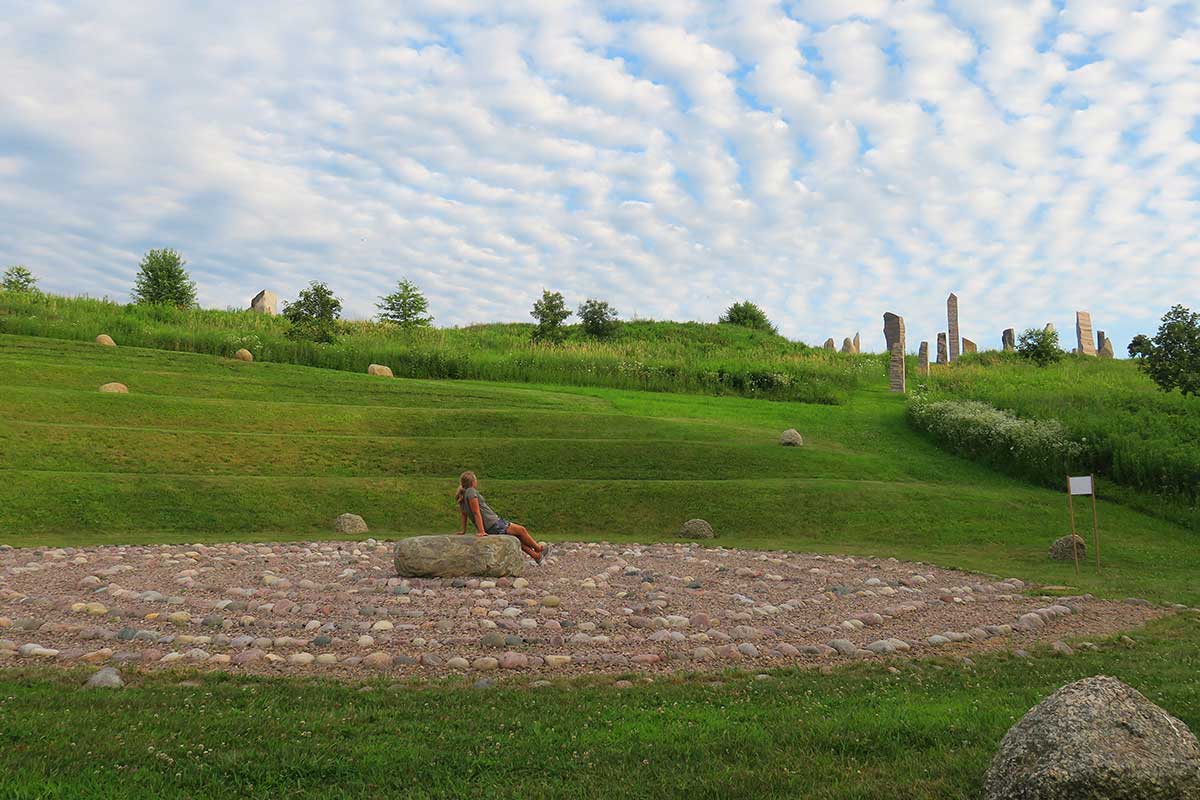
The Kinstone Labyrinth was designed by Kristine Beck in 2011 based on the 7-circuit, classical form. It was excavated on steep land which resulted in 5 erosion control terraces that step up-hill giving it the distinct feeling of an outdoor amphitheater. Landscape architect, Jay Fernholz, from Holmen, WI drew up designs for the terraces. Bob Baures and crew excavated the flat area and the terraces. Bob also placed the landscape fabric on the surface of the labyrinth, helped draw some of the path with chalk, and used his skid-steer to haul river rock and granite gravel stock piles down to the labyrinth site. The actual labyrinth was created with the help of 26 family and friends on Saturday, September 24, 2011; it took just 6 hours to complete the laying of stone lines and paths.
There is a special stone at the entrance that is called the “Welcome Mat” that has ancient ripple marks. This stone was found when excavating the sockets for the standing stones below the labyrinth and it was saved to serve as the entrance stone to the labyrinth. The stone lines are made with assorted rounded river rocks and the paths are a mix of champagne granite gravel (70%) and caramel quartzite gravel (30%). When walking this labyrinth the rhythmic crunch of feet on gravel brings to mind the sound of water lapping a pebbled beach or the steady beating of the heart.
For those wondering exactly what a labyrinth is – here is a definition: a labyrinth is a meandering path, often unicursal, with a singular route leading to a center. Usually you walk out of labyrinth using the same path you followed in.
Labyrinths are an ancient archetype dating back 4,000 years or more. Historically, there are various theories about their uses including that they are astronomical maps of planetary movements, doorways to the underworld, places for shamanistic rites and other ceremonial uses, symbols of birth, art, and more. Today they are commonly used symbolically as a walking meditation or a site for rituals and ceremony. Labyrinths are tools for personal, psychological and spiritual transformation, and are also thought to enhance right-brain activity. The Kinstone Labyrinth, like all labyrinths, evokes metaphor, sacred geometry, spiritual pilgrimage, religious practice, meditation and mindfulness, connection to center, environmental art, and community building.
