

IMPORTANT NOTICE: THIS CLASS IS CANCELLED due to COVID-19 (a.k.a. “coronavirus”). We believe this is the best course of action according to all sources and our decision is intended to help slow the spread of the virus and promote the safety of all.
Join us for this 3-hour hands-on experience and learn how to identify 25+ native trees solely by their winter characteristics like bark, branches, buds and scent.
This course is for ANYONE but may especially appeal to herbalists, biologists, botanists, life sciences students, farmers, homesteaders, permaculturists, homeowners, park goers, hikers, nature lovers, tree lovers and any who wish to get to know the trees a bit better.
Ever wonder how to tell oak from ash, or more importantly, ash from boxelder, when cutting firewood in the winter? Do you know trees well enough to find the oaks where hen-of-the-woods mushrooms are found, elms where morels might grow, or food and medicinal trees like basswood and black cherry in early spring?
Learning trees in the dormant season is ideal because tree bark, branches and buds are easily visible, and once you learn tree identification in the winter, it will be a snap when you come back in the summer and you can use their leaves to id them as well!
This course includes an introduction to tree identification in the classroom followed by a group walk to find, observe, and identify trees in the woodlands of Kinstone. Participants receive a summary handout that describes bark, bud, form, habitat and other identification tips.
Date: Saturday, March 28
Time: 1:00pm to 4:00pm (plan to arrive at least 15 minutes early!)
Cost: $30 No Refunds!
REGISTRATION / TICKETS: CANCELLED!
Level: Beginner to intermediate
Limited attendance! Sign up early to reserve your spot.
What to bring: bring a notebook and pen if you want to take notes.
Additional details: Rain, Snow or Shine. Dress for the weather and wear sturdy, warm boots and dress for the weather as we will be doing some winter walking across Kinstone and into the Kinstone woods! Participants should be physically able to walk up and down hills, through fields and woods and through snow if snow is still on the ground.
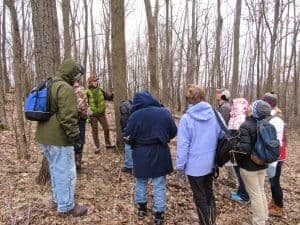
Dr. Cynthia Lane teaching a group about trees.
About your instructor: Cynthia Lane, Ph.D.
Cynthia has a passion for plants and has practiced botany right here in the Midwest as well as in the Northwest Territories in Canada all the way to Panama. She has 25 years of experience in the fields of natural resource management, landscaping and ecological research. She has a broad educational background with a Ph.D. in Conservation Biology, minoring in Forestry, and a B.S. in Horticulture and Botany. She has published papers or written reports on topics such as oak savanna, woodland and dune restoration, nursery management, endangered species recovery, insect and dune ecology, and GIS-based decision-making tools for urban ecological restoration. Dr. Lane has worked extensively in the Canadian Rockies, Boreal Forest, Midwestern United States, Florida and Panama. She served as Conservation Director for the Yellowstone-to-Yukon Conservation Initiative (Y2Y), as Conservation Ecologist for Florida’s Fairchild Tropical Garden, and as Program Director and Senior Ecologist at Great River Greening. Her expertise includes endangered species research, rare plant surveys, habitat restoration and monitoring, and conservation and restoration planning.
Here is an interesting article for you to read that may help you liberate yourself from tree blindness (note, you will need to log in to the New York Times in order to read it; you can log in for free if you do not have an account): Cure Yourself of Tree Blindness by Gabriel Popkin.
“Listen to all the teachers in the woods. Watch the trees, the animals, and all living things – you’ll learn more from them than from books.” ~Joe Coyhis, STOCKBRIDGE- MUNSEE
Photo credit: The largest photo in the collage featured as the main photo on this event is an image by Jörg Vieli and obtained from Pixabay. All other photos featured in the collage or in the body of this event page are credited to Kristine Beck, director of Kinstone.
